
Up to 70% IBF funding* T&Cs Apply , Cybersecurity Solutions 1
Up to 70% IBF funding* 2
Up to 70% IBF funding* T&Cs Apply , Cybersecurity Solutions 3
Up to 70% IBF funding* T&Cs Apply 4

Why Emotional Trading Is Costing Retail Investors Millions in 2026
Fear. Greed. FOMO. Panic selling. In today’s volatile markets, emotional decision-making may be one of the biggest threats to long-term investing success.
Markets are moving faster than ever.
Artificial Intelligence stocks are surging. Global indexes continue reaching new highs. Financial news spreads instantly across social media, trading apps, and AI-powered platforms.
Every day, investors are flooded with:
- Breaking market headlines
- Viral stock predictions
- “Hot” AI stock picks
- Fear-driven recession warnings
- Overnight trading success stories
For many retail investors, the pressure to react quickly has never been higher.
But beneath the surface, a dangerous problem is growing:
Emotional trading is silently destroying long-term investment performance.
And in 2026, this problem may be more serious than ever before.
What Is Emotional Trading?
Emotional trading happens when investors make decisions based primarily on:
- Fear
- Greed
- Excitement
- Panic
- Impatience
- Social pressure
Instead of following a structured investment framework, emotional traders often react impulsively to short-term market movements.
This usually leads to:
- Buying too late
- Selling too early
- Chasing hype
- Overtrading
- Poor risk management
- Inconsistent investing results
In volatile markets, emotions can become extremely expensive.
Why Emotional Trading Is Becoming More Common
Modern financial markets are designed to trigger emotional reactions.
Today’s investors are constantly exposed to:
- Real-time market notifications
- Social media opinions
- AI-generated predictions
- Fear-driven headlines
- Extreme market volatility
Unlike previous generations, investors now receive nonstop information every minute of the day.
While access to information has improved dramatically, it has also increased emotional pressure.
Many investors feel:
- They must constantly react
- They are “missing out”
- They need to trade more frequently
- Everyone else is making money faster
This creates dangerous psychological behaviour.
Because investing success rarely comes from emotional reactions.
The Psychology Behind Market Mistakes
Human psychology plays a massive role in financial markets.
Two emotions dominate investing behaviour:
Fear and greed.
Fear causes investors to:
- Panic sell during corrections
- Exit strong investments too early
- Avoid opportunities during uncertainty
Greed causes investors to:
- Chase overextended stocks
- Ignore risk management
- Overestimate short-term gains
- Take excessive risks
These emotional cycles repeat constantly across every market generation.
Even experienced investors can struggle emotionally during volatile periods.
That is why successful investing is often more psychological than technical.
The Rise of FOMO Investing
One of the biggest emotional traps in 2026 is:
FOMO — Fear of Missing Out.
Social media has amplified this dramatically.
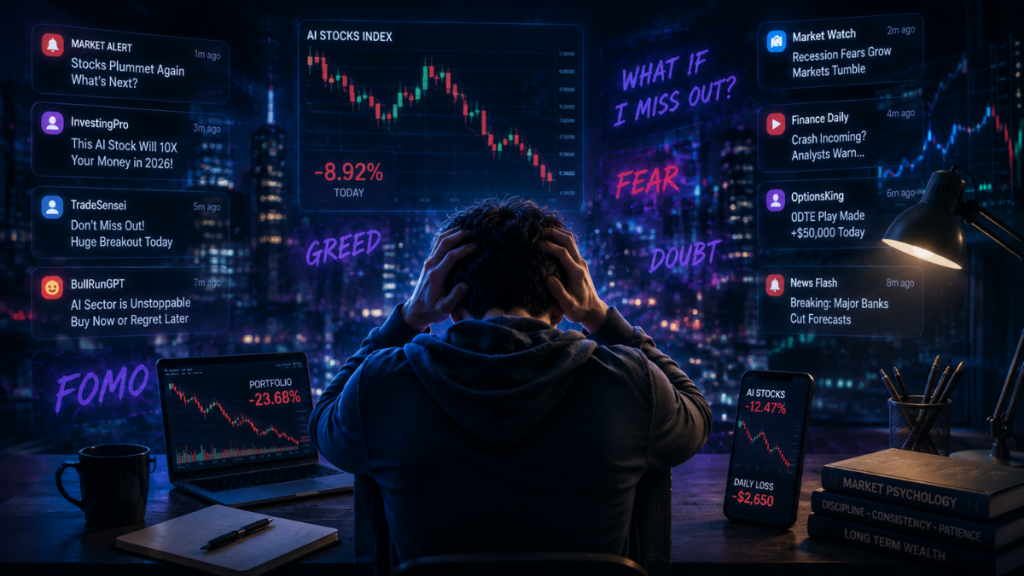
Investors constantly see:
- Massive profit screenshots
- Viral stock predictions
- AI stock hype
- Crypto rallies
- “Easy money” narratives
This creates emotional pressure to participate immediately.
Many investors end up:
- Buying at unsustainable prices
- Entering trades too late
- Ignoring proper research
- Taking risks they do not fully understand
Unfortunately, markets often punish emotional chasing.
By the time a trend becomes popular online, much of the easy opportunity may already be gone.
Why Risk Management Matters More Than Ever
One of the biggest differences between professional investors and emotional traders is risk management.
Experienced investors understand:
Protecting capital comes first.
They focus heavily on:
- Position sizing
- Portfolio allocation
- Risk-to-reward ratios
- Strategic entries
- Downside protection
Emotional traders often ignore these principles.
Instead, they:
- Overcommit capital
- Trade impulsively
- Increase position sizes emotionally
- React emotionally to losses
This creates long-term inconsistency.
In modern markets, risk management may be more important than stock selection itself.
Technology Has Made Emotional Trading Worse
Ironically, modern technology has made emotional investing easier.
Today:
- Trades can be executed instantly
- Market news spreads globally within seconds
- AI-generated opinions flood social media
- Investors can access markets 24/7
While technology improves convenience, it also increases emotional impulsiveness.
Many investors now trade too frequently simply because they can.
But more activity does not necessarily lead to better results.
In fact:
Overtrading is one of the most common signs of emotional investing.
Why Structured Investing Frameworks Matter
Successful investors rarely rely on emotions alone.
Instead, they develop structured systems.
This may include:
✅ Defined entry and exit rules
✅ Risk management frameworks
✅ Portfolio allocation strategies
✅ Market analysis systems
✅ Long-term investing plans
Frameworks help investors:
- Stay disciplined
- Reduce impulsive decisions
- Navigate uncertainty more calmly
- Maintain consistency during volatility
Without structure, emotions eventually dominate decision-making.
And emotional decisions often lead to inconsistent outcomes.
The Importance of Financial Education
In today’s fast-moving markets, financial education has become increasingly valuable.
Learning properly helps investors:
- Understand market cycles
- Improve emotional discipline
- Build risk awareness
- Develop long-term strategies
- Avoid common investing mistakes
Unfortunately, many beginner investors focus only on:
- finding winning stocks
instead of: - learning proper investing habits
But successful investing is rarely about one lucky trade.
It is usually the result of:
- consistency
- discipline
- patience
- continuous learning
Why Discipline Still Wins in the Long Run
Markets will always fluctuate.
There will always be:
- Bull markets
- Corrections
- Fear-driven selloffs
- New technologies
- Economic uncertainty
- Market hype cycles
But throughout history, disciplined investors have consistently outperformed emotional decision-makers over the long term.
Because investing success is not simply about reacting faster.
It is about:
- controlling emotions
- managing risk
- staying patient
- making informed decisions consistently
This is where emotional discipline becomes one of the most valuable investing skills.
Final Thoughts
In 2026, emotional trading may be one of the biggest hidden risks facing retail investors.
Modern technology, AI-generated content, social media hype, and constant market noise have created an environment where emotional decision-making becomes increasingly difficult to avoid.
But successful investing still depends heavily on:
- Discipline
- Risk management
- Patience
- Education
- Structured thinking
Because while markets evolve constantly,
human emotions remain remarkably consistent.
And in volatile markets, investors who learn how to manage emotions effectively may develop one of the strongest long-term advantages of all.
The modern market is moving faster than ever. Here’s why having the right investing knowledge, trading tools and market framework matters more today than ever before.
The Stock Market Is Hitting New Highs But Many Traders Are Still Losing Money
Artificial Intelligence stocks are soaring.
Global markets continue climbing despite inflation concerns, geopolitical conflicts and uncertainty around interest rates.
Every day, social media is filled with:
- “10X stock opportunities”
- Viral trading screenshots
- AI stock hype
- Overnight success stories
- Aggressive crypto predictions
To many beginners, investing in 2026 looks easy.
But behind the scenes, a different reality exists.
Thousands of retail traders are still:
- Buying at the top
- Panic selling during pullbacks
- Overtrading emotionally
- Losing money from poor risk management
- Following hype without understanding the market structure
The truth is simple:
The market rewards disciplined investors, not emotional traders.
And in today’s volatile environment, learning with the right tools and proper investing education has become more important than ever.
Why Trading Feels Harder in Today’s Market
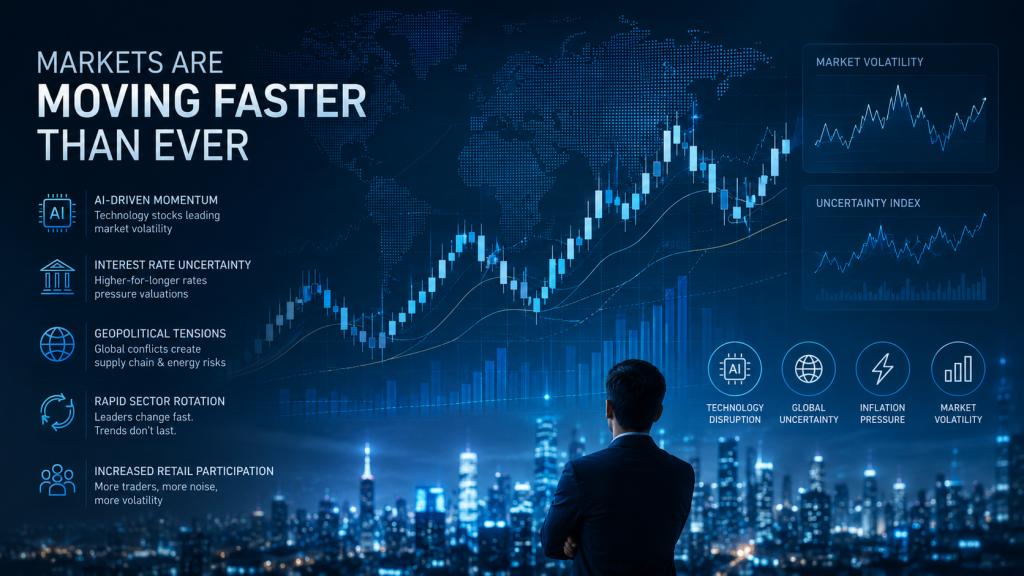
The financial markets have changed dramatically over the last few years.
Today’s market is heavily influenced by:
- Artificial Intelligence (AI) momentum
- Institutional algorithmic trading
- Interest rate uncertainty
- Geopolitical tensions
- Rapid sector rotation
- Social media-driven speculation
This creates extreme volatility.
Stocks can rally aggressively one week then collapse the next.
Many traders struggle because they rely purely on:
- Guesswork
- Online opinions
- Random indicators
- Emotional reactions
- “Hot stock tips”
Without a structured framework, most people eventually lose consistency.
The Biggest Mistake Beginner Investors Make
One of the most common investing mistakes today is believing that:
More information automatically leads to better investing decisions.
But information is everywhere now.
Anyone can access:
- Financial news
- YouTube analysis
- AI-generated stock commentary
- Free charting platforms
- Market opinions on social media
The real problem is not lack of information.
The real problem is:
Knowing how to filter noise from reality.
Successful investors understand:
- When to enter
- When to stay patient
- How to manage risk
- How market psychology works
- How to avoid emotional decision-making
This is why proper investing education matters.
Why Learning Investing and Trading Properly Matters
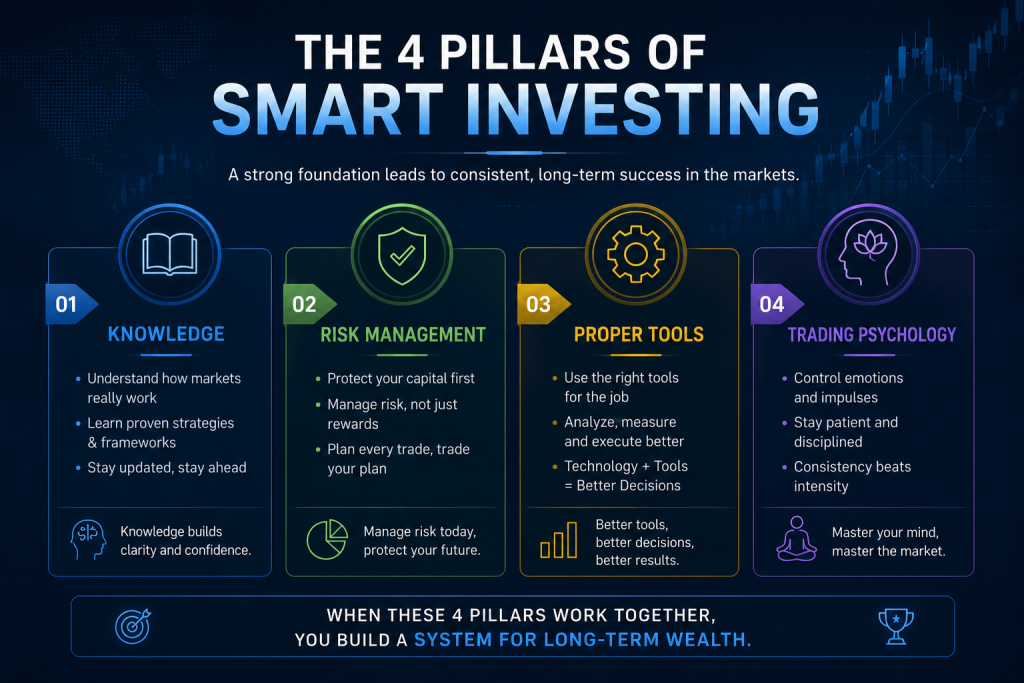
Many people enter the market hoping for quick profits.
Few spend enough time learning:
- Risk management
- Technical analysis
- Market cycles
- Position sizing
- Portfolio allocation
- Trading psychology
Without these foundations, even a good stock pick can turn into a bad trade.
Learning properly helps investors:
✅ Avoid emotional trading
✅ Build long-term consistency
✅ Improve risk management
✅ Develop structured decision-making
✅ Navigate volatile markets more confidently
The goal is not simply to trade more.
The goal is to make smarter decisions consistently.
Why the Right Trading Tools Matter in 2026
Modern investing is no longer just about buying stocks randomly.
Professional traders and experienced investors use tools to:
- Analyse price action
- Track momentum
- Monitor volume
- Identify market trends
- Manage downside risk
- Improve timing and execution
The right trading tools provide structure.
They help remove emotional decision-making during volatile market conditions.
Some examples include:
- Technical charting software
- Volume analysis tools
- Relative strength indicators
- Risk management systems
- Market scanning platforms
But here’s the important part:
Tools alone do not create successful traders.
Without proper knowledge, many beginners misuse indicators and overcomplicate their strategy.
That’s why combining:
- Education
- Experience
- Discipline
- Proper tools
creates a far stronger investing foundation.
Emotional Trading Is Costing Retail Investors Millions
One of the biggest reasons traders lose money is emotional behaviour.
This includes:
- Fear of missing out (FOMO)
- Panic selling during corrections
- Revenge trading after losses
- Overconfidence during bull markets
- Chasing trending stocks too late
Markets are designed to test emotions.
Successful investors rely on:
- Structured systems
- Clear frameworks
- Defined risk management
- Repeatable strategies
Not emotional reactions.
The Most Successful Investors Focus on Risk First
Professional investors understand an important principle:
Protecting capital is more important than chasing profits.
This mindset separates long-term investors from short-term gamblers.
Experienced traders focus heavily on:
- Downside protection
- Position sizing
- Portfolio balance
- Strategic entries
- Risk-to-reward ratios
Because surviving volatile markets is what creates long-term opportunities.
AI, Technology, and the Future of Investing
Artificial Intelligence is rapidly changing financial markets.
Today:
- Algorithms react faster than humans
- Market information spreads instantly
- Retail traders compete against institutional systems
- Volatility can increase within minutes
This means investors must evolve too.
The future belongs to people who:
- Continue learning
- Adapt to changing conditions
- Build strong frameworks
- Use proper investing tools
- Understand risk deeply
Not those chasing shortcuts online.
Final Thoughts: Knowledge Is the Real Investment Edge
In 2026, investing success is no longer about luck alone.
The investors who stay consistent are usually the ones who:
- Learn continuously
- Develop discipline
- Use proper tools
- Focus on risk management
- Follow structured frameworks
Because in modern markets:
Clarity is more valuable than hype.
And clarity comes from proper education, strong investing habits, and learning how to navigate markets with confidence.
Whether you are a beginner trader or a long-term investor, investing in the right knowledge today may become one of the most valuable financial decisions you make for your future.
The Threat Landscape Has Changed Permanently
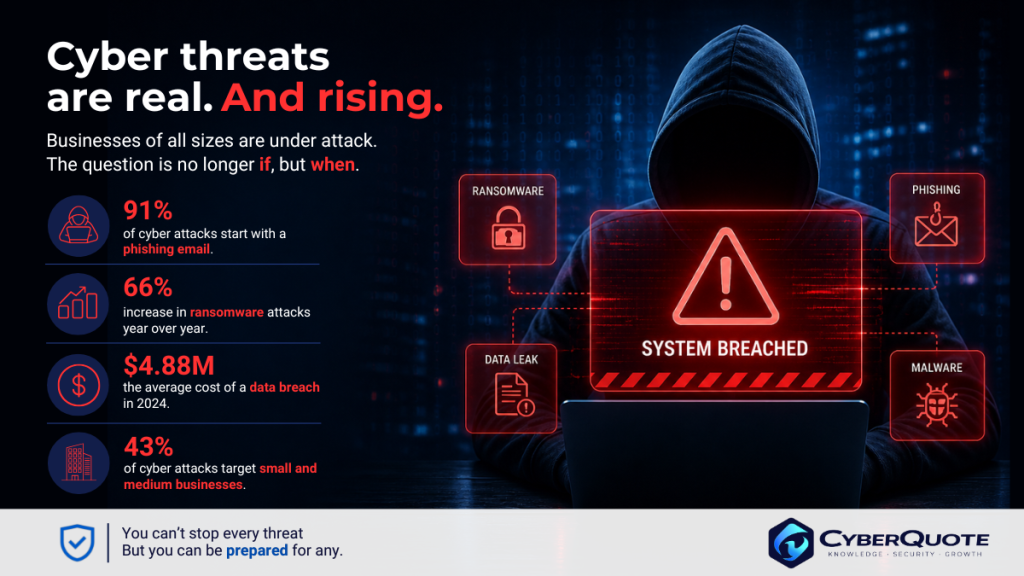
In recent months, cyber attacks have escalated in both frequency and sophistication. From ransomware crippling global operations to AI-powered phishing scams targeting employees, the nature of threats is no longer what it once was..
What’s different today isn’t just the number of attacks — it’s the speed, scale and precision.
Businesses are no longer being “randomly targeted.”
They are being systematically identified, assessed, and exploited.
And the reality is simple:
It’s no longer a question of if a cyber attack will happen — but when.
⚠️ Why Cybersecurity Is Now a Business Priority (Not Just IT)
Cybersecurity used to sit quietly under IT departments.
Today, it directly impacts:
- Revenue and operations
- Brand reputation
- Regulatory compliance
- Customer trust
A single breach can result in:
- Financial losses
- Legal consequences
- Operational downtime
- Long-term reputational damage
Yet many organisations are still underprepared, relying on outdated systems or fragmented security measures.
🔍 The Top Cybersecurity Threats Businesses Face Today
Understanding the threats is the first step to defending against them.
1. Ransomware Attacks
Attackers encrypt your systems and demand payment to restore access.
Many businesses never fully recover.
2. Phishing & Social Engineering
Highly targeted emails and messages designed to trick employees into revealing sensitive information.
3. AI-Powered Cyber Attacks
Attackers are now leveraging AI to:
- Automate attacks
- Mimic human behavior
- Bypass traditional detection systems
4. Insider Threats
Employees (intentional or accidental) are exposing sensitive data.
5. Unsecured Systems & Misconfigurations
One overlooked vulnerability can open the door to a full-scale breach.
🧠 A Practical Cybersecurity Framework Every Business Should Have
Most companies know cybersecurity is important but lack a clear structure.
Here’s a simple framework to think about:
1. Identify
Understand what assets, data, and systems need protection.
2. Protect
Implement safeguards such as:
- Firewalls
- Endpoint security
- Access controls
3. Detect
Monitor systems continuously to identify suspicious activity early.
4. Respond
Have a clear incident response plan to contain and mitigate damage.
5. Recover
Ensure business continuity and restore operations quickly.
The gap isn’t awareness, it’s execution.
🚫 Common Mistakes Businesses Still Make
Even today, many organisations fall into the same traps:
- Treating cybersecurity as a one-time setup
- Relying solely on basic antivirus solutions
- Lack of employee awareness and training
- No incident response plan
- Delaying action until after an attack
These gaps are exactly what attackers exploit.
📊 How Exposed Is Your Business Today?
Ask yourself:
- Do you know where your critical data is stored?
- Can you detect a breach in real-time?
- Is your team trained to handle phishing attempts?
- Do you have a tested response plan?
If the answer is unclear, your risk level may already be higher than expected.
🔐 How CyberQuote Helps You Stay Protected
At CyberQuote, we combine real-world expertise in financial markets and technology with proven security frameworks to help businesses:
- Identify vulnerabilities before attackers do
- Strengthen infrastructure and systems
- Implement practical, scalable security solutions
- Ensure compliance with industry standards
- Build long-term cyber resilience
We don’t just provide solutions, we help you build confidence in your security posture.
🎯 Take the First Step Towards Stronger Security
Cyber threats are evolving rapidly — but with the right approach, they can be managed effectively.
👉 Get a clearer view of your cybersecurity risks today.
- Book a consultation with our team
- Request a cybersecurity assessment
- Speak to us about your current setup
Don’t wait for a breach to take action.
📩 enquiry@cyberquote.com.sg
🌐 cyberquote.com/sg
📞 +65 6011 8921
Frequently Asked Questions About Cybersecurity
What is cybersecurity and why is it important?
Cybersecurity refers to the protection of systems, networks, and data from digital attacks. It is critical for safeguarding business operations and sensitive information.
How often should businesses review their cybersecurity?
Cybersecurity should be continuously monitored and reviewed regularly, especially as threats evolve.
Is cybersecurity only for large companies?
No, small and medium businesses are often the most targeted due to weaker defenses.
The strongest businesses today are not the ones avoiding cyber threats, they are the ones prepared for them.
How Businesses Can Stay Secure, Compliant, and Resilient
Cybersecurity is no longer just an IT concern, it is a business survival issue.
In today’s environment, companies are facing:
- Increasingly sophisticated cyber attacks
- Stricter regulatory requirements
- Higher financial and reputational risks
Yet many organisations still operate with reactive security measures, leaving critical gaps exposed.
This guide breaks down:
- The real cybersecurity risks businesses face today
- The most common vulnerabilities attackers exploit
- A practical framework to secure your organisation
- And how to move from compliance-driven to resilience-driven security
🚨 Why Cybersecurity Matters More Than Ever
Cyber threats are evolving faster than most organisations can respond.
Key trends shaping the threat landscape:
- Ransomware attacks targeting SMEs and enterprises alike
- API and web application vulnerabilities increasing
- Cloud misconfigurations becoming a major entry point
- Human error still the #1 cause of breaches
💡 Reality check:
Most breaches don’t happen because of “advanced hacking” — they happen because of basic security gaps left unaddressed.
⚠️ The Most Common Cybersecurity Gaps in Businesses
Even well-established companies often overlook critical areas:
1. Weak Server Hardening
Unsecured servers are one of the easiest entry points for attackers.
2. Lack of Vulnerability Assessment & Penetration Testing (VAPT)
Without testing, you’re operating on assumptions, not facts.
3. Poor Access Control
Too many users have unnecessary privileges.
4. Outdated Systems
Unpatched software is a goldmine for attackers.
5. No Incident Response Plan
Many companies don’t know what to do after a breach happens.
🧩 The Cybersecurity Framework Every Business Needs
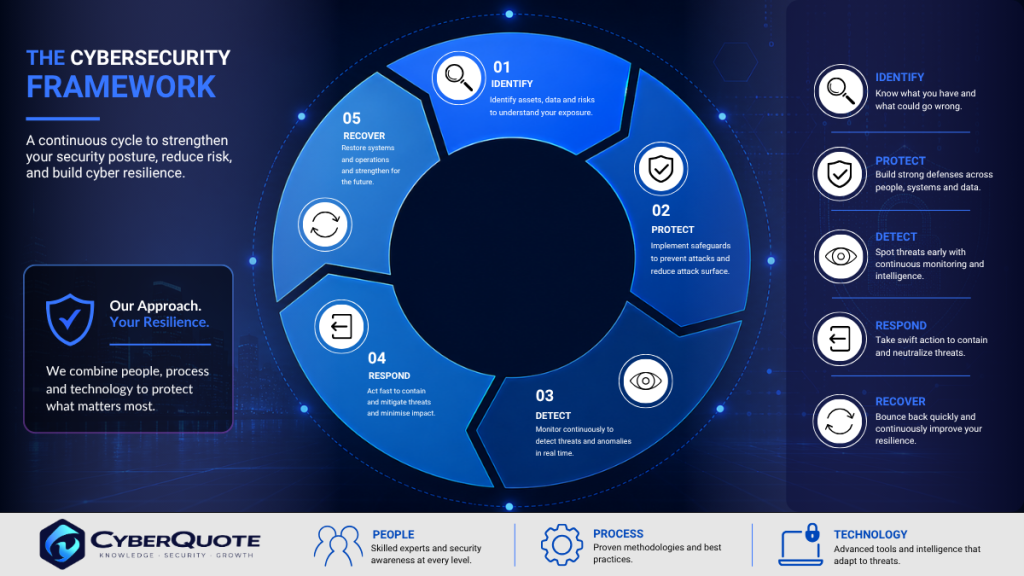
Instead of random tools, businesses need a structured approach.
Step 1: Identify
- Map critical systems, data, and assets
- Understand your risk exposure
Step 2: Protect
- Implement server hardening
- Secure endpoints and networks
- Enforce strong access controls
Step 3: Detect
- Continuous monitoring
- Threat detection systems
Step 4: Respond
- Incident response planning
- Containment strategies
Step 5: Recover
- Backup and disaster recovery
- Business continuity planning
🛡️ Key Cybersecurity Solutions That Actually Make a Difference
Instead of trying everything, focus on what delivers real impact:
✅ Server Hardening
Reduces your attack surface significantly.
✅ VAPT (Vulnerability Assessment & Penetration Testing)
Identifies real-world exploitable weaknesses.
✅ Secure Infrastructure Design
Build systems securely from the ground up and not patch later.
✅ Continuous Monitoring
Because threats don’t happen once, they happen constantly.
📉 The Cost of Doing Nothing
Many companies delay cybersecurity investments until it’s too late.
But the real cost includes:
- Financial loss
- Regulatory penalties
- Operational downtime
- Loss of customer trust
💡 One breach can cost far more than years of proactive security.
🚀 From Compliance to Competitive Advantage
Cybersecurity is no longer just about avoiding risk.
It can become a business advantage:
- Builds trust with clients and partners
- Enables smoother audits and compliance
- Strengthens long-term operational resilience
Companies that invest early are not just safer, they are more competitive.
📌 How to Get Started (Without Overcomplicating It)
If you’re unsure where to begin, start with:
- A security assessment
- A clear gap analysis
- Prioritised action steps based on risk
Avoid trying to “do everything” and focus on what matters most first.
🎯Don’t Wait for a Breach to Take Action
If you’re unsure about your current security posture, the first step is clarity.
👉 Understand where your risks are before attackers do.
At CyberQuote, we help businesses:
- Identify real vulnerabilities
- Strengthen infrastructure security
- Implement practical, scalable solutions
📩 Get a Complimentary Security Consultation
- Understand your current gaps
- Receive actionable recommendations
- No obligation — just clarity
👉 Speak with our team today
🌐 https://sg.cyberquote.com/contact-us/
📧 enquiry@cyberquote.com.sg
📞 +65 6011 8921
Most companies only act after something goes wrong.
The smarter ones act before it happens.The difference isn’t budget.
It’s timing.